
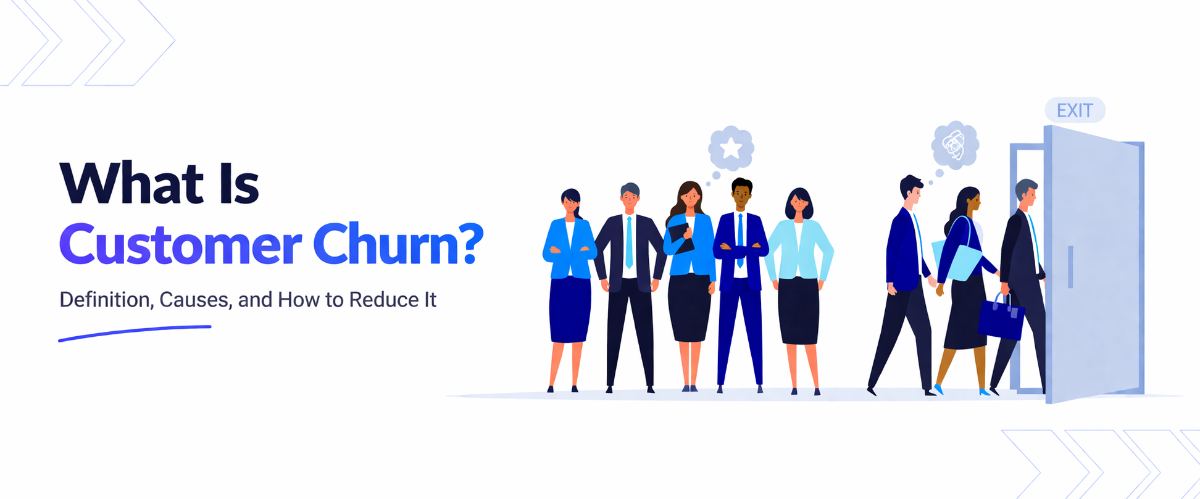
Churn is the single most destructive metric in SaaS. Revenue growth gets the attention, but churn decides whether that growth compounds into a valuable business or leaks out the back door as fast as it comes in.
A SaaS company with 50% year-over-year growth and 5% monthly churn is not actually growing. It's running a treadmill. Half the customers you acquire this year will be gone by year-end. The next year's growth has to first rebuild what was lost before adding anything new. That's why sophisticated investors and acquirers often care more about retention than growth rate growth without retention is rented revenue, not earned revenue.
This guide covers what churn actually is, the different types (most of which are regularly confused), how to calculate each correctly, realistic benchmarks by segment, why customers actually leave, and a practical playbook for reducing churn. Most churn is preventable if you know where it comes from and intervene early. The companies that treat churn as a first-class priority not an afterthought compound for years. The ones that don't eventually stall out.
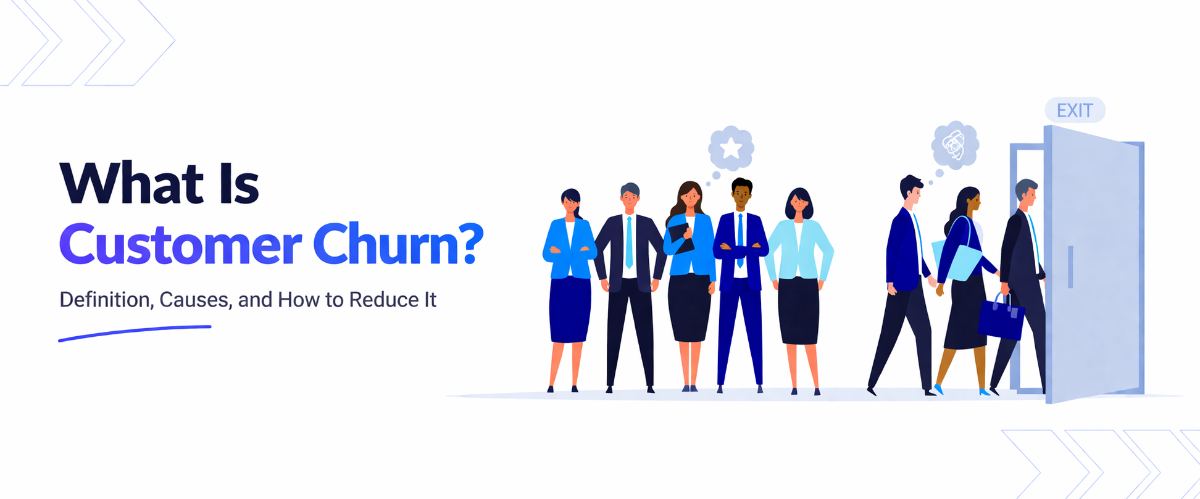
Table of Contents
What is churn?
The different types of churn
How to calculate churn
Gross vs net revenue retention
Why churn matters so much
Churn benchmarks by segment
Why customers churn
The churn reduction playbook
Reducing involuntary churn
Measuring, tracking, and acting on churn
When churn is healthy
FAQ
What is churn?
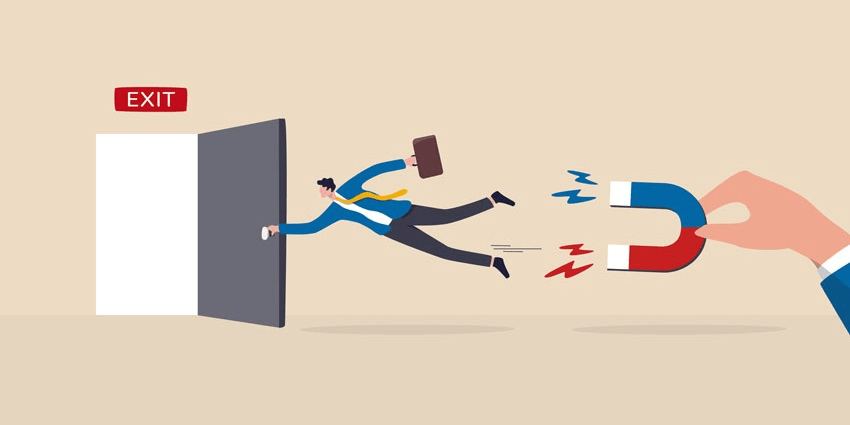
Churn is the rate at which customers or revenue leave a SaaS business over a given period. A 5% monthly churn rate means that of the customers (or revenue) you had at the start of the month, 5% are gone by the end.
It's measured in two primary forms customer churn (how many accounts are lost) and revenue churn (how much money is lost) and each of those has further variants. The terminology gets confusing fast, and companies frequently compare non-comparable numbers. A churn figure is only meaningful when you know exactly what it measures and over what period.
At its core, churn is the inverse of retention. 95% monthly retention = 5% monthly churn. They're the same measurement, framed oppositely.
The different types of churn
Five churn concepts every SaaS operator should be able to distinguish.
Customer (logo) churn
The percentage of customers who cancel during a period, regardless of how much they were paying.
Formula: Customers lost during period ÷ Customers at start of period
If you started the month with 500 customers and 25 cancelled, logo churn is 5%.
Customer churn is useful for understanding the raw retention of your customer base. It doesn't distinguish between a £50/month customer cancelling and a £50,000/month customer cancelling, so used alone it can miss the revenue picture entirely.
Revenue churn
The percentage of MRR (or ARR) lost during a period from customers who cancelled or downgraded.
Formula: MRR lost during period ÷ MRR at start of period
Two customers cancelling could produce anywhere from 0.1% to 40% revenue churn depending on their size. Revenue churn is what ultimately hits the business.
Gross churn vs net churn
Gross revenue churn measures only the negative: revenue lost through cancellations and downgrades. It ignores expansion from existing customers.
Net revenue churn nets expansion against the losses: lost revenue minus revenue gained from existing customers upgrading. Net churn can be negative meaning your existing customer base is generating more revenue this period than it was last period, even with some customers leaving. Negative net churn is the holy grail of SaaS.
Both are important. Gross churn tells you how leaky your bucket is. Net churn tells you whether expansion is outpacing the leak.
Voluntary vs involuntary churn
Voluntary churn is when a customer actively chooses to cancel. They called in to cancel, clicked the cancel button, or gave formal notice. Their intention was to leave.
Involuntary churn (sometimes called "passive" or "delinquent" churn) is when a customer stops paying because of payment failure expired card, failed transaction, declined charge, insufficient funds not because they decided to leave.
This distinction is enormous because involuntary churn is largely a billing and payments problem, not a product or customer success problem. For most SaaS companies, 20–40% of total churn is involuntary, and a meaningful portion of that is recoverable with decent payment operations.
Early vs later-life churn
Most SaaS businesses lose customers in two distinct phases: early (within 90 days of sign-up) and later (at renewal points or after several years). The causes differ early churn is usually about onboarding and product-market fit failure, while later-life churn is more about diminishing value or changing customer circumstances. Breaking out your churn by customer tenure reveals which phase is your primary leak.
How to calculate churn
The formulas look simple. The complications come from edge cases, consistent treatment, and what you include in the denominator.
Basic monthly customer churn
Customer Churn Rate = (Customers lost during the month ÷ Customers at the start of the month) × 100
Example: Start of March, 1,000 customers. 40 cancelled during March. Customer churn = 40 ÷ 1,000 = 4% monthly churn.
Basic monthly revenue churn
Revenue Churn Rate = (MRR lost during the month from churn and contraction ÷ MRR at start of month) × 100
Example: Start of March MRR = £500,000. Cancelled customers took £15,000 of MRR. Existing customers who downgraded cost another £5,000. Total lost = £20,000. Revenue churn = £20,000 ÷ £500,000 = 4%.
Annualised churn
Converting monthly to annual churn isn't a simple multiplication by 12. Because each month's churn compounds on a smaller base, annualised churn is slightly less than 12 × monthly churn.
Approximate formula:
Annual Churn ≈ 1 − (1 − Monthly Churn)^12
5% monthly churn ≈ 46% annual churn, not 60%. The compounding effect makes the reality of high monthly churn more stark once annualised.
Cohort-based churn
The most rigorous form. Rather than measuring churn across your whole customer base in a single period, cohort churn tracks specific customer groups (e.g. everyone who signed up in January 2025) over time. You can see exactly how month-one, month-two, month-six, and month-twelve retention look.
Cohort analysis reveals patterns that aggregate churn hides whether a specific acquisition channel produces high-churn customers, whether pricing changes affected retention of newer vintages, whether onboarding improvements actually reduced early churn.
Common denominator issues
What counts as a "customer"? A single-seat user on your cheapest plan? A free trial? A paused account? You need to define the denominator consistently.
New customers mid-period. If you acquired 100 customers mid-March, do they count in the denominator for March's churn calculation? Conventions vary. Most teams exclude mid-period additions (only customers present at the start count) to avoid artificially depressing the rate.
Time window boundaries. A customer who cancels on 31 March March churn or April churn? Pick a convention (usually the period in which the cancellation was effective) and apply it consistently.
Gross vs net revenue retention
The retention-focused counterparts to churn, and the metrics investors most commonly ask about.
Gross Revenue Retention (GRR)
GRR measures how much of the starting MRR from a cohort of customers you still have from that same cohort at the end of the period, excluding any expansion.
Formula:
GRR = (Starting MRR − Churned MRR − Contraction MRR) ÷ Starting MRR
Example: Start the year with £1M MRR from existing customers. Over the year, £100K churned and £30K contracted. GRR = (1,000,000 − 100,000 − 30,000) ÷ 1,000,000 = 87%.
GRR caps at 100% it can't exceed starting MRR because it ignores expansion.
Net Revenue Retention (NRR)
NRR adds expansion into the picture. Same cohort, same period, but now credit the expansion revenue from those customers.
Formula:
NRR = (Starting MRR − Churned MRR − Contraction MRR + Expansion MRR) ÷ Starting MRR
Example: Same as above, plus £200K of expansion from that cohort. NRR = (1,000,000 − 100,000 − 30,000 + 200,000) ÷ 1,000,000 = 107%.
NRR above 100% means your existing customer base is growing on its own expansion is outpacing churn and contraction. This is what investors lovingly call "negative churn" and what drives premium SaaS valuations. A SaaS company with 120% NRR doesn't need to acquire new customers to grow it grows automatically from the customers it already has.
Benchmarks
GRR. 90%+ is strong. 85–90% is acceptable for SMB SaaS. Below 80% raises concerns.
NRR. 100%+ is healthy. 110%+ is strong. 120%+ is best-in-class. Sub-90% NRR is a warning sign even if acquisition is growing.
These metrics are typically measured over trailing 12 months and on a cohort basis.
Why churn matters so much
Four compounding reasons churn is the most valuable metric to control.
Churn is the multiplier on LTV. Customer lifetime value = Average revenue per customer × gross margin ÷ churn rate. Half the churn doubles the LTV. Double the churn halves it. The dollar impact is linear to churn in one direction and compounding in the other.
Churn is the biggest driver of SaaS valuations. Buyers and investors pay premiums for businesses with strong retention because the future revenue is more predictable. A company with 95% GRR will have substantially more revenue in year three than a company with 80% GRR, even if they start identical. That translates directly into higher valuation multiples.
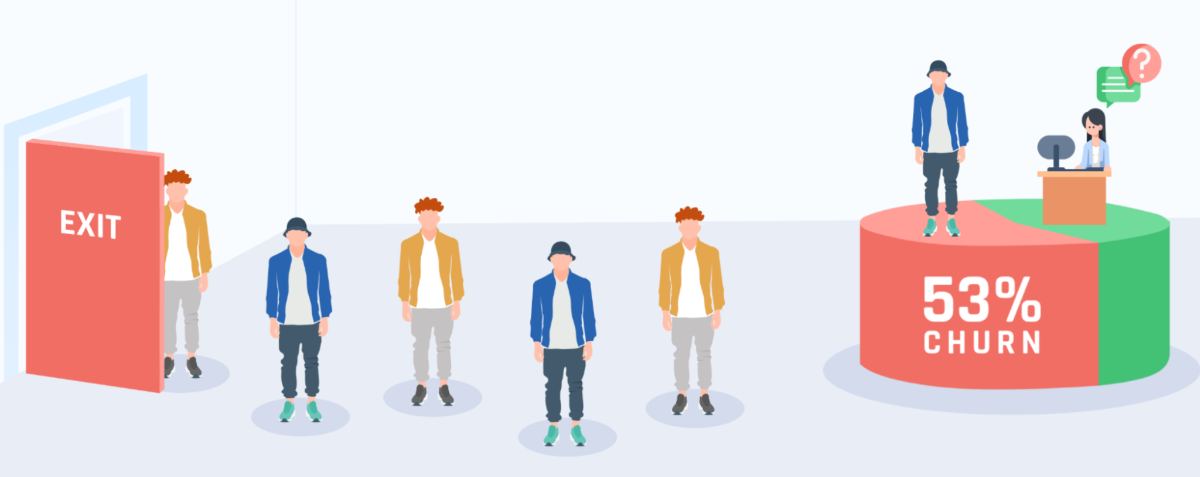
Churn compounds unforgivingly. Growth compounds too, but churn compounds against you with no ceiling. At 5% monthly churn, you lose nearly half your customer base annually. At 10% monthly churn, you lose two-thirds annually. Acquisition has to overcome this leakage before adding anything incremental, which is why high-churn businesses struggle to scale profitably.
Churn limits the value of acquisition investment. If you spend £1,000 to acquire a customer who churns in six months, you likely haven't made your money back. High churn means your CAC has to come way down, which restricts how you can grow (no paid acquisition, only low-cost channels) or you simply lose money per customer indefinitely.
A useful mental model: growth brings you new customers. Retention determines whether they become the foundation for a durable business or just temporary revenue. Companies that neglect retention eventually hit a growth ceiling they can't engineer their way past because every new customer acquired just replaces one lost.
Churn benchmarks by segment
SaaS churn varies enormously by market segment, product type, and business model. Context matters.
By customer segment
SMB SaaS (small business customers, self-serve): 3–7% monthly logo churn is typical. 2–3% is strong. 5%+ is concerning but common. Annual contract customers in the SMB space typically see 15–25% annual churn.
Mid-market SaaS: 1–2% monthly churn. Annual churn of 10–15% is typical. Contracts are usually annual, churn largely concentrated at renewal points.
Enterprise SaaS: Under 1% monthly (often 0.3–0.8%). Annual churn of 5–8%. Contracts are multi-year, and churn events are rare but individually large.
Consumer SaaS: Highly variable. Monthly churn of 5–10% is common. Some consumer SaaS categories see 15%+ monthly churn and make it work through volume.
By product category
Mission-critical infrastructure (databases, payments, communication): Very low churn. Customers can't easily leave.
Horizontal productivity tools: Moderate churn. Competition is broad.
Vertical SaaS (industry-specific): Often very low churn. Switching costs and workflow integration are high.
Creative tools: Higher churn. Subscribers fluctuate with projects.
Marketing/analytics tools: Moderate-to-high churn. Budget cuts hit these categories first in downturns.
A sense check
If your monthly revenue churn is above 5% and you're selling to anything other than consumers or very small SMBs, you almost certainly have a retention problem that needs addressing before scaling acquisition.
Why customers churn
Churn reasons tend to fall into a small number of categories. The distribution across these categories reveals where to invest in prevention.
Onboarding failure. The customer signed up, couldn't figure out how to get value quickly, and gave up. Accounts for a disproportionate share of first-30-day churn. Signal: customers churning before ever meaningfully using the product.
Missing product-market fit. The product doesn't solve the problem the customer thought it would, or solves it too poorly. Signal: churn reasons like "didn't fit our needs" or "we needed features you don't have."
Poor value perception. The product works, but the customer doesn't feel they're getting enough value for the price. Signal: churn concentrated around renewal discussions, downgrade requests, and "too expensive" feedback.
Competitor displacement. A competitor offered something better, cheaper, or more aligned to the customer's needs. Signal: churn to named competitors; often correlated with product marketing and positioning gaps.
Champion departure. The person who bought and advocated for your product left their company. Their replacement either doesn't understand the value or prefers a tool they used before. Signal: unexpected churn from previously happy accounts; often happens 3–9 months after the champion's departure.
Company change. The customer's business fundamentally changed they got acquired, shut down, pivoted, lost funding, downsized. Signal: churn reasons tied to customer's business rather than product.
Product bugs, outages, or reliability issues. Trust got broken. Sometimes a single bad incident causes churn months later. Signal: support ticket history correlates with churn; Net Promoter Score drops.
Underutilisation. The customer bought more than they needed. They'd happily pay for a smaller tier but feel stuck paying for what they have. Signal: contraction requests or churn at renewal with "not using enough" as the reason. This one often presents as churn but is actually solvable through right-sizing.
Pricing change reaction. You raised prices, changed packaging, or introduced new limits, and customers pushed back by leaving. Signal: churn spike following a pricing or packaging change.
Economic environment. Budget cuts, cost-cutting mandates, broader economic pressure. Signal: industry-wide churn across your peers; correlates with macro indicators.
Involuntary / payment failure. Covered separately below fundamentally a different problem from voluntary churn.
Disciplined churn analysis captures a reason code for every cancellation. Over time, the distribution across these categories is the strategic roadmap for where retention investment pays off.
The churn reduction playbook
Churn reduction isn't one intervention. It's a set of parallel programmes, each targeting a different churn driver. The full playbook:
1. Nail onboarding
First-30-day churn is often the largest single churn bucket. Customers who don't get to value quickly leave. Onboarding fixes with the highest impact:
Define the specific "aha moment" the action that indicates the customer has understood and used the core value. Measure how many customers reach it, and in what timeframe.
Redesign the first-use experience to drive toward that moment as directly as possible. Remove friction, auto-fill what you can, skip optional setup that can be done later.
Segmented onboarding paths for different customer types. A marketing team onboarding is not the same as an engineering team onboarding, even for the same product.
Human-assisted onboarding for higher-value customers. For SMBs, a scheduled kick-off call at signup can cut month-one churn materially.
Progress indicators and gentle nudges when customers stall. "You haven't connected your calendar yet here's why it matters" beats silence.
2. Build a real customer success function
For B2B SaaS above a certain ACV, customer success is the single highest-ROI retention investment. The specific models vary, but the essentials:
Segmented coverage. Not every customer needs a dedicated CSM. Tier your base: high-touch for large customers, low-touch programmatic for mid-market, fully automated for SMB. Spend proportional to value at risk.
Clear outcomes. CSMs should be measured on retention, expansion, and customer health scores not vanity activity metrics.
Proactive outreach. Don't wait for customers to surface problems. Review usage patterns, reach out to at-risk accounts before they notice they're at risk.
Executive business reviews. For enterprise customers, quarterly business reviews that demonstrate value delivered are a major retention lever.
3. Build customer health scoring
A customer health score is a composite metric combining product usage signals, support interactions, NPS/CSAT feedback, billing health, and qualitative CSM observations into a single red/yellow/green or numeric indicator of churn risk.
Done well, health scoring predicts churn 60–90 days in advance enough lead time to intervene. The inputs vary by product, but strong signals typically include:
Decline in daily or weekly active users
Drop in core feature usage
Increase in support tickets
Missed milestones or adoption benchmarks
Negative NPS or CSAT responses
Late payment history
Champion logged out or departed
Scoring lets you focus the customer success team on the customers most at risk, rather than spreading attention evenly.
4. Reduce friction in the product
Customers rarely announce they're about to churn. They show it through behavioural changes slower usage, fewer features touched, less engagement. Common friction points that drive invisible churn:
Slow performance
Bugs in workflows customers use daily
Poor mobile experience
Painful integrations with tools customers rely on
Confusing onboarding for new users joining existing customer teams (the champion leaves, no one trains the next person)
Continuous product improvement driven by customer feedback loops not just feature requests but behavioural data is a direct churn reducer.
5. Get pricing and packaging right
Pricing drives churn both ways. If pricing feels too high for the value delivered, customers leave or downgrade. If pricing is structured so customers are always one tier higher than they need to be, they leave to avoid overpaying.
Effective interventions:
Clear, aligned tier boundaries that match how customers actually use the product
Usage-based or hybrid pricing that automatically adjusts to customer value rather than forcing downgrade decisions
Option to pause instead of cancel
Right-sizing offers at renewal ("we noticed you're only using 40% of your licences here's a lower tier that fits better")
Transparent pricing that builds trust rather than gotchas that create resentment
6. Shift to annual contracts
Monthly contracts allow churn to happen any month. Annual contracts concentrate churn decisions to once per year and give you twelve months to deliver enough value that the renewal is obvious.
Incentives for annual commitments 10–20% discounts, additional features, priority support typically pay for themselves many times over through improved retention. Some SaaS businesses move from 5% monthly churn on monthly plans to 10% annual churn on annual plans, a dramatic improvement.
7. Run win-back campaigns
Not every churn is permanent. Customers leave for reasons that change budget freezes lift, priorities shift, competitors disappoint. Win-back campaigns targeting former customers 90 days, 6 months, and 12 months after cancellation recover 5–15% of churned revenue in most SaaS businesses.
Elements of effective win-back:
Acknowledge why they left and explicitly address what's changed
Introduce new features or improvements relevant to their previous use case
Offer meaningful incentives (discount, extended trial, migration help)
Time outreach strategically not the week after they left, but months later when the reason for leaving may have evolved
8. Capture exit reasons religiously
Every cancellation should produce a reason code. Done consistently over time, this is your churn diagnostic. The specific drivers get investment; the non-drivers don't. Without this data, churn reduction is guesswork.
Common formats: a short exit survey (3–5 questions, multiple choice + optional free text), a CSM exit conversation, or a combination of both.
9. Contract structure matters
Beyond annual vs monthly, contract specifics affect churn:
Auto-renewal clauses. Industry-standard but increasingly scrutinised; ensure they're legally clean in every jurisdiction you operate in.
Termination-for-convenience windows. Some contracts let customers cancel without penalty at specific points. Narrower windows reduce mid-term churn.
Minimum commitments. Sometimes combined with ramp pricing the customer commits for longer in exchange for a lower first-year rate.
10. Segment your retention strategy
One retention strategy rarely works across all customer types. Enterprise customers respond to executive engagement and strategic value alignment. SMBs respond to product simplicity and price. Self-serve customers need in-product interventions, not outbound calls. Build retention programmes that match the customer you're trying to retain.
Reducing involuntary churn
Involuntary churn payment failure is probably the biggest overlooked opportunity in SaaS retention. For many companies, 20–40% of gross churn is involuntary. Most of that is recoverable.
Implement automated card updaters. Services integrated with Visa, Mastercard, and major processors automatically update expired or replaced card details without the customer intervening. A basic hygiene practice that recovers meaningful churn.
Smart dunning. When a payment fails, don't just send "your payment failed" emails. Intelligent dunning sequences retry payments at optimal times (certain days of the week, certain times of month have higher success rates), send increasingly actionable communications, and escalate to account suspension or manual outreach only after multiple attempts.
Retry failed payments intelligently. Some processors retry aggressively and damage customer relationships; others give up too quickly. Finding the right retry schedule (often around 2, 4, and 7 days after initial failure, plus retry on the next billing cycle start) recovers a substantial percentage of failures.
Pre-dunning. Warn customers before their card expires. A simple "your card ending in 4321 expires next month please update" message prevents the failure from happening in the first place.
Multiple payment methods. Offer bank transfer, direct debit, and local payment methods in addition to cards. Reduces single-point-of-failure risk and expands your addressable market.
Grace periods. Don't suspend service the day a payment fails. Giving customers a 5–10 day grace period to resolve payment issues avoids turning a card failure into a cancellation.
Monitor and resolve quickly. Set up alerts for payment failures and have someone actually look at them. Personal outreach for higher-value accounts recovers payments that automated sequences miss.
Companies that invest seriously in payment recovery routinely cut total churn by 20–30% and see immediate ROI. There's no other retention intervention with such directly measurable impact.
Measuring, tracking, and acting on churn
Good churn management is as much about operational discipline as it is about any single metric.
Dashboard what matters. Monthly logo churn, monthly revenue churn (gross and net), churn by cohort, churn by segment, churn by plan, churn by acquisition channel. Look at all of these regularly.
Review churn weekly at an operational level. Churn should be a standing topic in customer success, product, and revenue leadership meetings. Rolled-up quarterly reviews are too slow to catch emerging patterns.
Track reason codes over time. If the "too expensive" bucket is growing, pricing needs attention. If "missing features" is growing, product investment needs to target specific gaps. If "poor onboarding" is growing, go fix onboarding.
Segment every analysis. Aggregate churn can hide a collapsing segment. Churn for customers on the Enterprise plan, churn for customers acquired through paid search, churn for customers in financial services look at these separately.
Build cohort retention curves. For each monthly or quarterly acquisition cohort, plot retention over time. You'll quickly see which cohorts retain well and which don't, and identify what changed that produced the difference.
Intervene earlier. The biggest improvement most SaaS teams can make is shifting from reactive (intervening when a customer expresses intent to cancel) to proactive (intervening when health scoring indicates risk 60 days out). The earlier the intervention, the more likely it works.
When churn is healthy
Not all churn is bad. Some is productive.
Bad-fit customers churning out is a good outcome. If you accidentally sold to a customer who was never going to get value from your product, the sooner they leave the better. High-touch retention of bad-fit customers is expensive and they'll eventually leave anyway. Better to recognise the fit mismatch early and move on.
Customers who've outgrown your product. If a customer has scaled beyond what your product serves, churning them is correct. What matters is the segment they represent whether they should have stayed and you lost them to a better product, or whether they genuinely moved to a tier of customer you don't serve.
Strategic churn as part of a pricing overhaul. Sometimes a deliberate pricing change pushes out low-value customers to improve overall unit economics. This looks like churn in aggregate numbers but is actually a margin-improvement action.
What matters is distinguishing healthy churn (bad-fit, outgrown, strategic) from unhealthy churn (product failure, competitive displacement, champion loss, onboarding failure, payment failure). Healthy churn is bounded. Unhealthy churn metastasises.
FAQ
What's the difference between churn rate and retention rate?
They're inverses. 95% retention = 5% churn. Same measurement, opposite framing.
Should I focus on logo churn or revenue churn?
Both, but weight revenue churn more. Customer count matters, but revenue is what pays the bills and drives valuation. For mixed customer bases (some large, some small), revenue churn is the more honest indicator.
How often should I measure churn?
Monthly at minimum. Weekly for fast-moving parts of the business (acquisition cohort retention, involuntary churn recovery). Quarterly for strategic reviews.
My churn rate is high. Where do I start?
Segment first. What's your SMB churn vs your enterprise churn? Voluntary vs involuntary? First-30-day vs later-life? The specific pattern determines the intervention. Aggregate "churn too high" has no single solution.
Can negative churn be sustained?
Yes, if expansion continues to outpace the gross loss. Many category-leader SaaS companies maintain NRR above 120% year after year. It requires a product that naturally grows with customer usage (seats, consumption, data volume, transaction count) and a customer success motion that actively drives expansion.
How do I compare my churn to benchmarks?
Only compare within your segment. SMB benchmarks are wildly different from enterprise. B2B benchmarks are different from B2C. Horizontal productivity benchmarks are different from vertical SaaS. Find peers similar to you and compare carefully.
What's a reasonable churn reduction goal?
Cutting churn in half is a significant project and usually takes 12–24 months of sustained effort across product, customer success, and billing. Smaller incremental improvements (20–30% reduction) are often achievable in a single quarter by focusing on one specific driver (payment recovery, onboarding, specific at-risk segment).
Does raising prices always increase churn?
Not always. Well-communicated price increases, grandfathered for existing customers or paired with new value delivery, often produce modest churn spikes that are more than offset by the revenue uplift. Poorly-handled price increases without supporting narrative or value evidence can produce severe churn. The execution matters as much as the pricing decision.
What churn rate is acceptable?
Depends on your segment. For early-stage SMB SaaS, 3–5% monthly is survivable. For mid-market, 1–2% monthly is expected. For enterprise, anything above 1% monthly is a problem. More important than the absolute rate is the trajectory is it improving, stable, or getting worse?
How does churn affect valuation?
Enormously. Two SaaS businesses with identical ARR but different churn profiles will be valued very differently. The one with 90% GRR and 110% NRR might trade at 8x ARR; the one with 75% GRR and 95% NRR might trade at 3x. Churn reduction is, dollar-for-dollar, one of the highest-ROI investments in SaaS.
Churn reduction is not glamorous work. It's slow, cross-functional, iterative, and rarely produces dramatic wins in a single quarter. But no other investment in a SaaS business compounds as favourably. A one percentage point reduction in monthly churn doesn't just save you a percentage point of revenue it extends customer lifetimes, lifts LTV, allows you to spend more on acquisition, and raises the enterprise value of the company at exit.
The SaaS companies that treat retention as a core, sustained programme with executive ownership, cross-functional investment, and disciplined measurement build durable businesses that reward patient capital. The ones that chase growth without matching retention investment eventually stall.
Find your biggest churn drivers. Invest systematically against them. Measure honestly. Repeat.
Ready to buy or sell a SaaS business?
Join SaaSMarket to browse verified listings or list your own SaaS for sale.